



Stephen Smysnuik
Should Canada become the EU's first "associate member"?
Should Canada become the EU's first "associate member"?
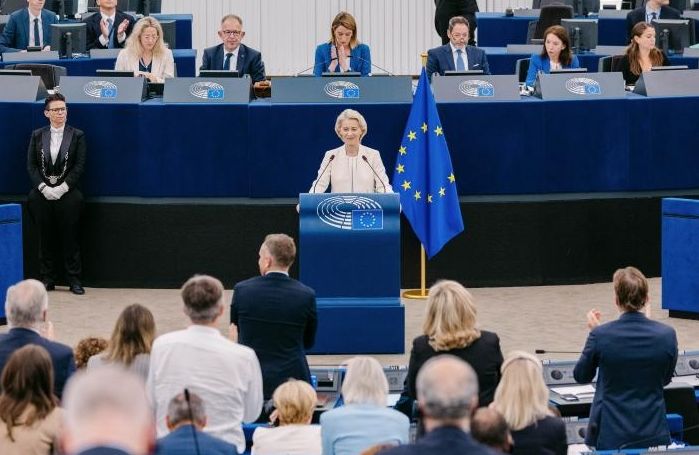
Image: European Commission
The Topline
- European Commission President Ursula von der Leyen proposed last week to make Canada the EU's first-ever "associate member” during her State of the Union address
- The following day, Prime Minister Mark Carney welcomed the idea at the European Parliament in Strasbourg, calling for an "alliance for the future"
- “Associate member” status doesn't currently exist in any EU treaty, and details of the proposal are expected to be discussed further at a Canada-EU summit in Montreal in October
- Conservative Leader Pierre Poilievre told supporters at a campaign rally this past weekend that “Canada will never be the 28th state of the European Union.”
- Carney also told reporters in Strasbourg that the idea will be debated in Ottawa and Parliament will vote on any proposed alliance
Never miss another side to every story
Sign up for The Level's 5-minute newsletter, 3x per week
Thanks for subscribing!
Check your inbox for an email to confirm you're on the list. If there's no email, check your spam filter just in case, then mark us as 'not spam' so that you never miss an issue.
Switch sides,
back and forth
Finally, a real alternative to Washington
Canada's entire economic strategy has, for decades, been to align itself with the U.S. as much as possible.
U.S. President Donald Trump, however, demonstrated in a very short amount of time what happens when your closest trading partner decides to weaponize that relationship.
Carney made that clear when he told the European Parliament in Strasbourg, "Financial mechanisms have been used for coercion. Supply chains constitute weak points to be exploited.”
All this to say, Canada’s looking for a new trading partner, and an associate membership in the EU, whatever its final shape, is the nation’s best option.
This isn’t Canada trading away its sovereignty to be governed by EU rules. Carney said he's not pursuing full EU membership, describing it instead as a "unique alliance" covering critical minerals, defence, AI, energy, digital trade and financial services — the sectors where Canada is most exposed to U.S. pressure right now.
Deeper ties with a 27-nation bloc of nearly 450 million people, with an economy large enough to rival the U.S., give Canadian exporters, workers and companies a genuine alternative to absorbing whatever mood swing comes out of the White House next.
The opening comes after Canada spent the summer proving it wouldn't fold to Trump's bullying tactics on tariffs and sovereignty. Europe, meanwhile, watched an ally get bullied by its own largest trading partner and seems to have decided that an unprecedented invitation of solidarity was called for.
Trump's furious reaction is itself the best evidence of how this threatens the leverage he's created. If coercion from U.S. tariffs works simply because Canada has nowhere else to turn, then having a European alternative might be the shield Canada doesn’t currently have.
Von der Leyen framed the proposal as building "a common prosperity and economic security space.” Translation: Europe needs secure, democratic suppliers of critical minerals and energy as it works to reduce its own dependence on both the U.S. and China.
Canada holds exactly the resources — lithium, nickel, uranium, LNG — that Europe's manufacturing and defence buildup require.
For Canada, Finance Minister François-Philippe Champagne has already started making the pitch directly to European counterparts, calling Canada a potential "supplier of choice" for European markets looking to bolster energy security and defence capabilities.
It's a rare deal where both sides' core vulnerability is the other side's core strength. And the timing couldn’t be better.
Expect way too many strings attached
“Nobody really knows what it means.”
That’s literally what one EU diplomat told Politico about Canada becoming an EU “associate member.”
Another said creating a genuine associate-membership status would require amending the EU's founding treaties, calling that "impossible" given the current lack of support among member states.
Just take Germany, for example. Berlin specifically opposes fast-tracking special status for Canada over concerns about what it would mean for the EU's other partners.
Even Jonathan Wilkinson, Canada’s new ambassador to the EU, has pumped the brakes, saying "We are not looking to be a member of the European Union, because that is a sovereignty issue, and people give up certain portions of their sovereignty [to join]."
If you’re worried Canada will give up too much, take comfort in knowing there’s a good chance this thing never comes together at all. The trade deal Canada already has with the EU — The Canada-European Union Comprehensive Economic and Trade Agreement (CETA) — still hasn’t fully entered into force, nearly a decade after it was signed.
Ten member states, including France, Italy and Poland, still haven't ratified it. Agreements with the EU can take forever to fully implement because you’re dealing with the internal bureaucracies of over two dozen member states.
Even if a deal eventually gets struck, there are bound to be strings attached.
The closest existing model for this kind of access to the European market might be Norway and Iceland’s participation in the European Economic Area.
It took years of negotiation, and both countries still have to follow many EU rules without having any right to vote on them.
This is precisely what Carney has said Canada plans to avoid. But a Globe and Mail analysis of the proposal found that without full membership, Canada would become "a rule-taker with no say on policy."
Then there’s the practical matter of whether this makes an already dire U.S. relationship worse. President Donald Trump has already called the potential agreement a "hostile act."
With Canada sending 75 per cent of its merchandise exports to the U.S. — versus just 6 per cent to the EU — it’s a gap large enough to make you wonder how much this partnership could realistically change Canada’s trade reality.
And by pursuing this now, in the middle of an active trade war, Carney risks not just failing to diversify Canada's options, but further provoking the single relationship Canada still can't afford to lose.
Do you support journalism that helps Canadians navigate difficult issues with more context and less outrage?
CHIP IN TO SUPPORT THE MISSION ✨
Every dollar goes to explaining, comparing, and helping Canadians form their own opinion.
